What is Forward-Deployed AI Engineering? How It Works and When to Use It
Most AI pilots never make it to production. The model usually works; the problems come from messy data, integrations and security reviews. Here’s what forward-deployed engineering is, how an engagement runs, and when it beats AI consulting or traditional outsourcing.
 Shashwat Gupta · · 11 min read
- engineering
- forward-deployed engineering
- ai implementation
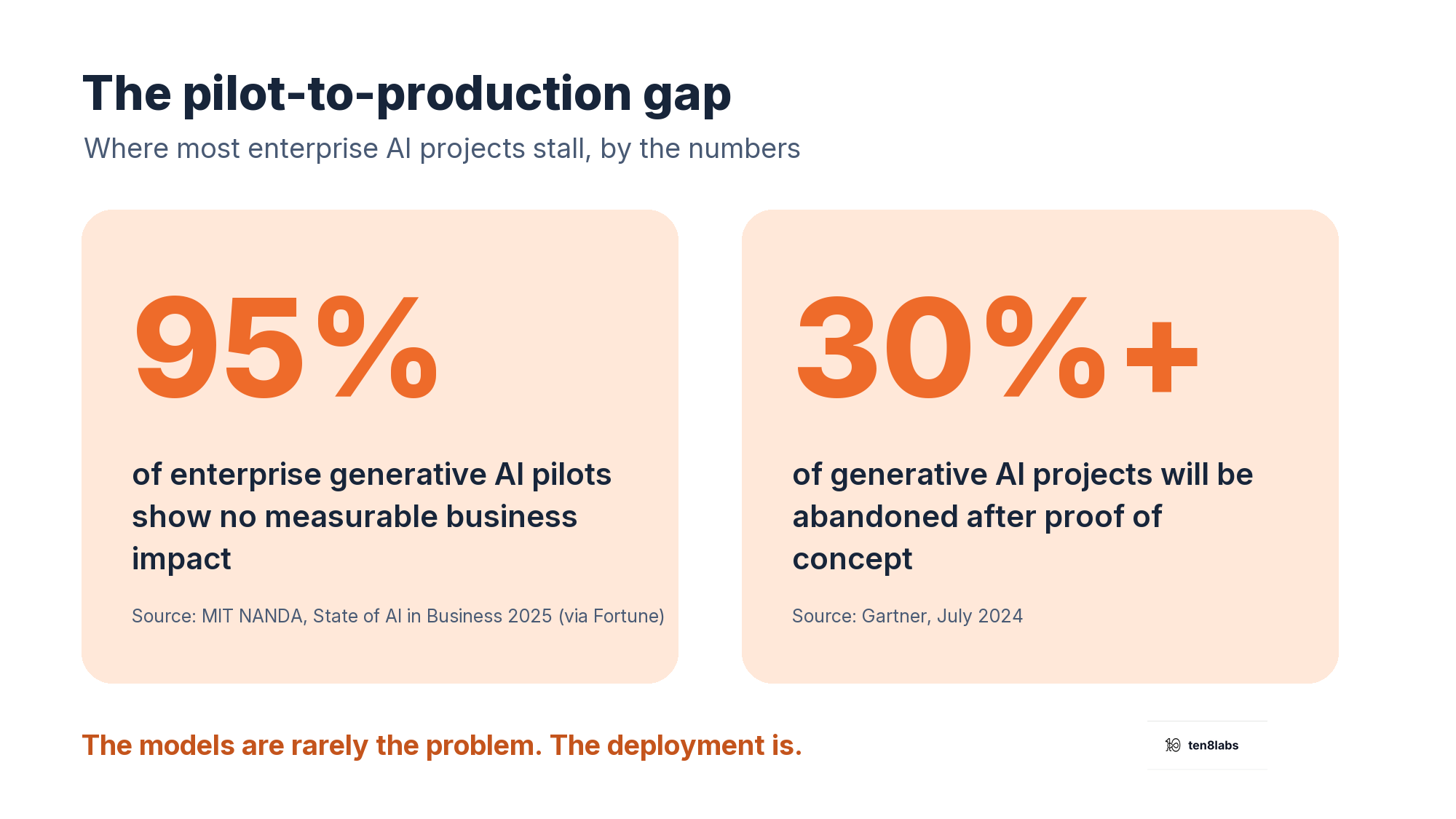
Your team runs a beautiful AI demo. It lands in the room, the stakeholder deck gets approved, and then the project stalls for months in integration work, data cleanup, and security reviews. It is not bad luck. MIT's NANDA initiative found that 95% of enterprise generative AI pilots produced no measurable business impact, and Gartner's 2026 analysis found that at least 50% of generative AI projects were abandoned after proof of concept by the end of 2025, citing poor data quality, inadequate risk controls, escalating costs, and unclear business value.
The pattern behind both numbers is the same: a working prototype is not a production system, and the distance between the two is mostly operational, not model-level. Forward-deployed engineering is a delivery model built for exactly that distance: engineers embed inside your team and your systems to design, build, and run production AI, rather than advising from the outside or building to a fixed spec offsite. This is the first article in a series on the model: what it is, how an engagement runs, when it beats hiring a consultant or an outsourced development team, and what it costs.
What is forward-deployed engineering?
Forward-deployed engineering is the practice of placing engineers directly inside the customer's environment to ship working systems. The people who do it are forward-deployed engineers (FDEs): software engineers who embed with your team, inside your tools and workflows, to design, build, and ship AI against your real business problems. An FDE writes production code, connects it to your systems, and stays until it runs, measuring outcomes against your baseline rather than handing over recommendations.
Palantir coined the role in the early 2010s while working with US intelligence agencies, whose problems could not be specified up front and whose data could not leave the building. The embedded engineers were so central to the business that until 2016 Palantir employed more forward-deployed engineers than traditional software engineers, according to an analysis in The Pragmatic Engineer.
What does the day-to-day of a FDE look like?
An FDE maps your workflows and data, adapts frontier research to your use case, builds and hardens the system, and works directly with your domain experts. Barry McCardel, who spent almost five years in a Palantir forward-deployed role, describes the culture this way: field teams were empowered to do whatever the problem needed, including inventing entirely new products, and customer deployments were proving grounds for what later migrated into the core platform.
The difference from a traditional software engineer is not talent, it is position. A product engineer optimizes for the platform; an FDE optimizes for your environment, its constraints, its mess, and its deadlines. Nabeel S. Qureshi's reflections and Ted Mabrey's piece on what is and is not an FDE both land on the same point: the role is engineering plus judgment plus customer-facing ownership, and companies that relabel their field consultants "FDEs" without the engineering mandate are doing something else entirely.
Why forward-deployed engineering matters for AI implementation
The hard part of AI implementation was never the model. Ask anyone who has taken an AI proof of concept to production and the same walls show up.
Data quality and accessibility: The demo ran on a clean export. Production runs on your ERP extracts, your ticketing system, your scanned invoices, and the tribal knowledge in your team's heads. Making that data usable, governed, and fresh is engineering work, not a configuration step.
Existing systems and integrations: An AI feature that does not plug into your CRM, your document management, and your approval workflows is a chatbot in a browser tab. Integration is where most of the work hides, and it is the one demos skip.
Security, reliability, and operational requirements: Production means access controls, audit trails, monitoring, exception handling, and predictable behaviour under real load. These are the costs Gartner itself cites for abandoned projects, discovered mid-project.
None of these walls is a model problem. They are context problems, and the model itself is increasingly commoditized while the deployment knowledge is not. That is why the FDE works embedded with your teams rather than at advisory distance: your engineers know the business, and the AI engineers know how models fail at scale.
How does forward-deployed AI engineering work?
Engagements differ by company, but most follow a representative implementation lifecycle of five stages.
- Understand the business problem: The team embeds with yours, maps the workflow end to end, and picks the step where AI moves a number that matters. Expected outcomes get defined against a measurable baseline.
- Define scope and architecture: Technical requirements, integrations, acceptance criteria, and eval criteria get agreed before code is written, so "done" means your team's definition, not the vendor's.
- Build and integrate: The AI solution is built and connected to your actual business systems, adapted to your data and workflows rather than the other way around.
- Test and deploy: Reliability, security, exception handling, and production readiness get hardened before go-live, inside your tools.
- Monitor and transfer ownership: Post-deployment, the system is measured against the baseline, tuned as your data and business change, and handed over with documentation and support so your team owns it.
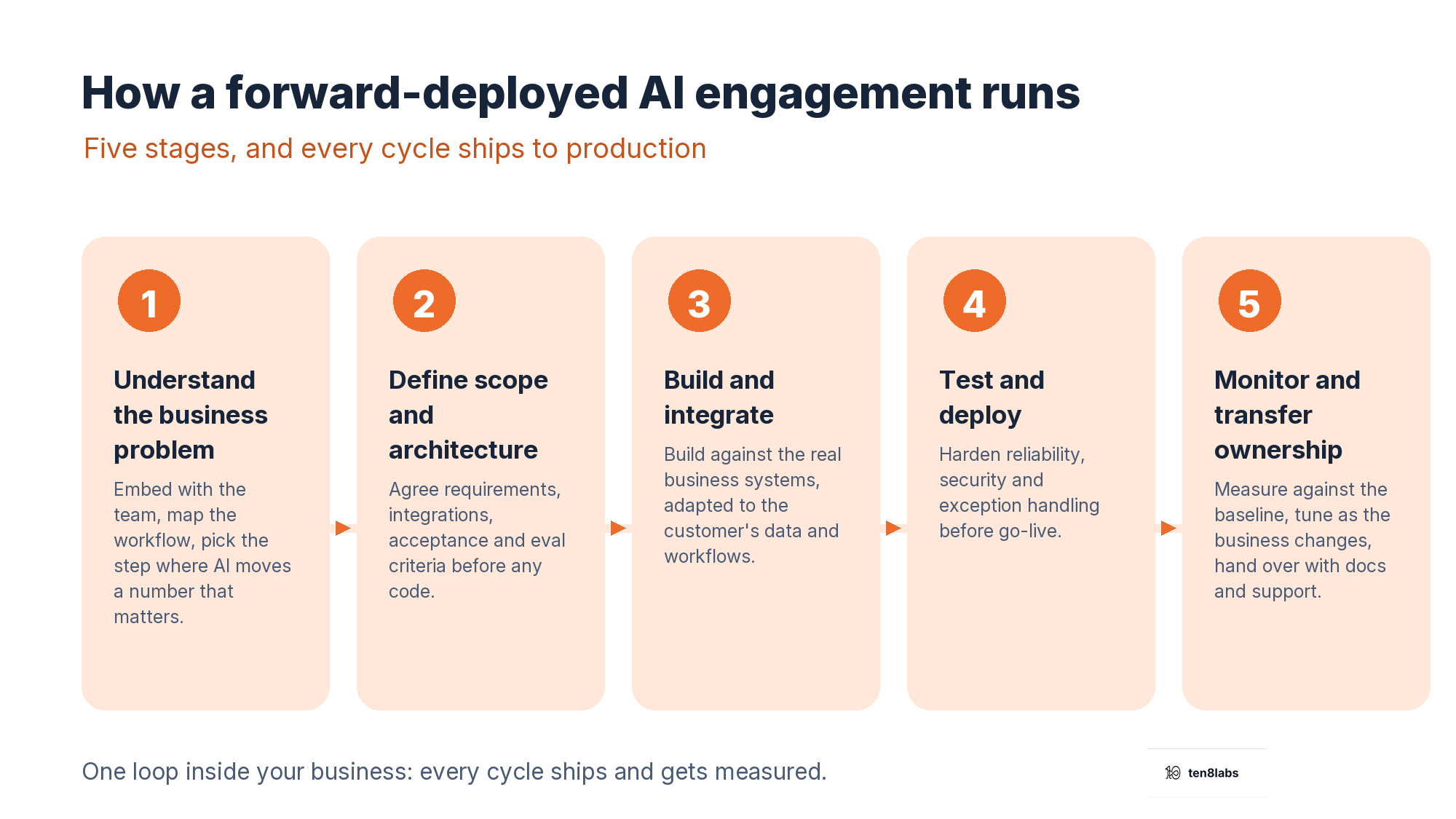
ten8labs runs its engagements on a version of this loop, described on our ten8labs services page.
Forward-deployed engineering vs AI consulting vs traditional outsourcing
The forward-deployed engineer model sits between two familiar purchases. AI consulting services analyze, recommend, and often prototype; traditional AI development services deliver a fixed-scope build to a specification. The table below shows where they differ.
| Dimension | Forward-deployed engineering | AI consulting | Traditional outsourcing |
|---|---|---|---|
| Primary purpose | Ship a working system in production | Advise, recommend, and often prototype | Deliver a fixed-scope build |
| Where the team works | Embedded with your team, onsite or inside your environment | External, advisory distance | External, offsite |
| Who writes production code | The embedded team | Usually your team, after the report | The vendor |
| Customer collaboration | Continuous, side by side | Workshops and checkpoints | Requirements then handover |
| Scope flexibility | High; evolves with what the work reveals | Medium; fixed to the engagement | Low; change orders |
| Typical project fit | Complex AI integration with unclear, shifting requirements | Strategy, roadmaps, vendor selection | Well-specified, stable builds |
| Ownership after go-live | Transferred to you, with support | Ends with recommendations | Vendor may retain maintenance |
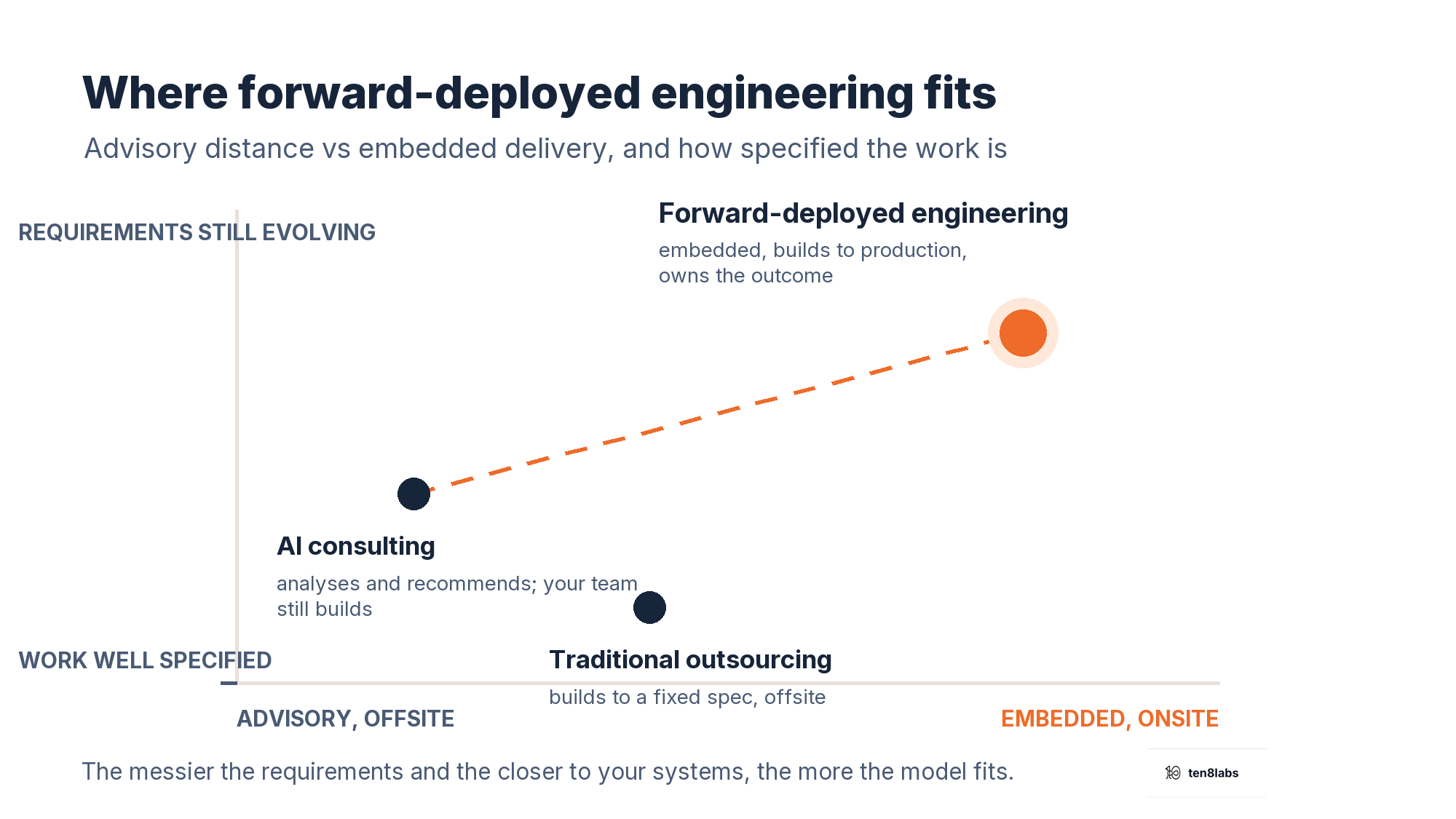
Palantir's own history offers a useful test when you compare vendors: its version worked because the engineers in the field were the same calibre as its core product engineers and were building systems, not recommendations. McCardel is blunt that slapping the title on a field team, without the cost and culture behind it, produces "just sparkling Sales Engineering". Mabrey's field test is simpler: does the person write production code against your real constraints, or do they configure a demo and leave?
Where forward-deployed AI engineering earns its keep?
The pattern across use cases is the same: high-value workflows where AI must connect to existing systems and be measured against a business outcome.
Workflow automation: AI-enabled steps wired into the business processes your team already runs, not beside them. Think invoice matching against POs, or claims routed automatically with humans handling exceptions.
Enterprise Content and Video: Producing multilingual training videos, marketing creatives, and product explainers from a company's existing material, localized into Indian languages and kept on brand.
Enterprise knowledge systems: One place to ask anything about the business, connected to internal data sources while respecting access requirements, with cited answers leaders can verify.
Conversational AI: Voice and chat assistants integrated with enterprise systems, escalating to humans with full context when a person is genuinely needed.
ten8labs works across all four, plus adjacent areas like e-commerce personalization and fraud detection; the full list of its AI engineering services is on its capabilities page.
When should a business consider forward-deployed engineering?
The model fits when the problem is genuinely ambiguous: complex AI integration requirements across several systems, business and technical requirements still evolving, or a prototype that has to become production. It also fits when the bottleneck is frontier knowledge. Internal teams know the business deeply but rarely have time to track what frontier models can and cannot do, how to design evaluations, or what data the system actually needs. Someone who arrives with that knowledge, embedded rather than advisory, closes the loop faster than a team learning it mid-project.
Traditional development remains the right answer when the work is well understood: a documented API, a predictable integration, a product with a large community of people who have already solved it. In that case a conventional AI integration services contract will do. Where this sits in your AI implementation strategy comes down to one honest test: if you can fully specify the system up front, outsource it normally. If you cannot, but it must still ship and work, that is the forward-deployed case.
Why is the role the need of the hour?
The model's second life is recent. In early May 2026, Anthropic announced an enterprise AI services firm with Blackstone, Hellman & Friedman, and Goldman Sachs, and on May 11 OpenAI formalized its forward-deployed approach at scale with The Deployment Company, a majority-owned subsidiary embedding FDEs into enterprise clients. OpenAI, Anthropic, Google Cloud, Palantir, Salesforce, Databricks, Adobe, and Scale AI all now hire FDE-style roles, and OpenAI's own FDE job posting describes leading complex deployments of frontier models "where model performance matters, delivery is urgent, and ambiguity is the default."
For businesses, that wave is a signal about where the industry thinks AI value actually gets created: not in another model, but in deployment. For engineers and job seekers, it has opened a new hybrid engineering track, one we will return to later in this series.
How ten8labs supports AI engineering and implementation?
ten8labs is a research-and-deployment team: frontier AI research applied inside your business. The founding team pairs deployment and research depth: co-founder Shashwat Gupta brings eight-plus years building AI products in enterprise software, including leading a 25-person team at Eli Lilly that shipped a customer data platform credited with a $20M revenue lift, while co-founder Abhinav Jain spent five and a half years as an Applied Scientist at Amazon Prime Video with eleven patents filed or granted in computer vision and multimodal AI.
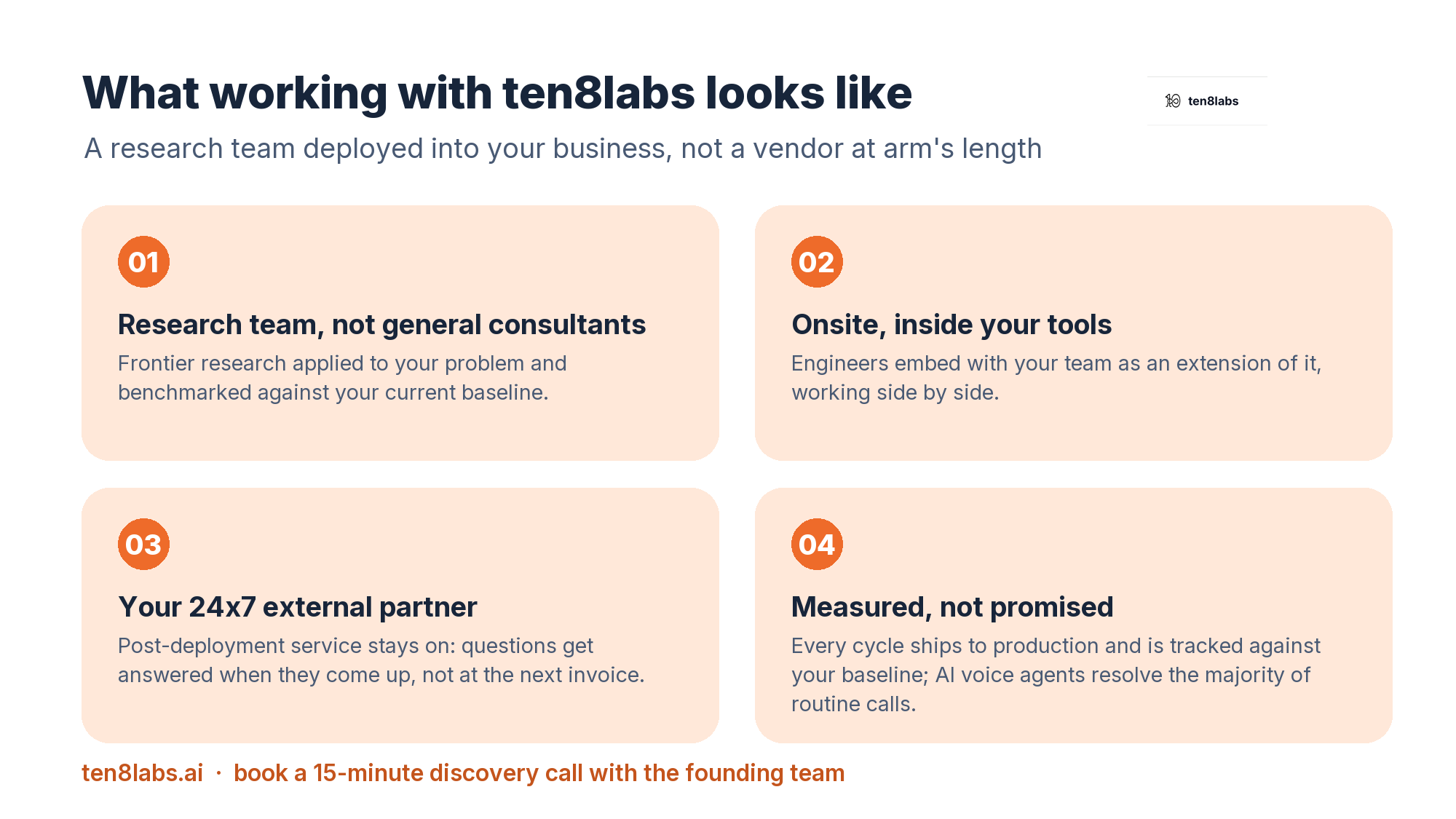
What working with the team looks like: ten8labs engineers work onsite with your team, in your tools, as an extension of it. Its AI voice agents handle around 95% of routine inbound calls, handing over to people with full context when a human is needed. Support does not end at go-live: ten8labs provides post-deployment service and stays reachable as your 24x7 external partner, so questions get answered when they come up.
Every engagement ships to production and is measured against your baseline, and ten8brain, its decision-context product, keeps the context alive for your team after the handoff with every answer traced back to its source. For teams evaluating an AI implementation partner or AI implementation company for a complex build, those engagement mechanics, not the title, are the checklist.
Bring the workflow you want to improve. ten8labs' founding team then will map where AI fits, what integration will take, and what a production-ready path looks like, before anything gets built.
Frequently asked questions
What is a forward-deployed engineer?
A software engineer who embeds with your team to build and ship production systems against your real workflows, writing production code rather than recommendations.
How is a forward-deployed engineer different from a software engineer?
A product engineer optimizes the platform; an FDE optimizes your environment, owns the integration, and works directly with your domain experts until the system runs in production.
Is forward-deployed engineering the same as AI consulting?
No. Consultants analyze and recommend; forward-deployed engineers implement and own delivery, and stay until the system is measured working against your baseline.
When should businesses hire forward-deployed engineers?
When requirements are complex or still evolving, when several systems must be integrated, or when a prototype has to reach production and internal frontier-AI expertise is the bottleneck.
What is the difference between a forward-deployed engineer and a solutions engineer?
A solutions engineer supports sales with demos and technical validation; an FDE writes production code inside your systems and owns implementation end to end.
How much does forward-deployed AI engineering cost?
It varies by use case, and ten8labs prices engagements by outcome and impact rather than a day rate: a first project is scoped on a discovery call, and larger engagements are sized by the workflows involved and the extent of post-deployment support.
The takeaway: choose the model that fits the problem
Most AI projects do not fail because the model was wrong. They fail in the space between a demo and a production system: data, integrations, security, and the context needed to get the details right. Forward-deployed engineering exists for that space. If your problem is well specified, outsource it normally. If it is not, but it still has to ship and be measured, that is exactly what the model is for.
If you want to discuss your AI implementation project, book a discovery call with the ten8labs founding team.
Sources
- https://fortune.com/2025/08/18/mit-report-95-percent-generative-ai-pilots-at-companies-failing-cfo/
- https://www.gartner.com/en/articles/genai-project-failure
- https://newsletter.pragmaticengineer.com/p/forward-deployed-engineers
- https://www.barry.ooo/posts/fde-culture
- https://nabeelqu.co/reflections-on-palantir
- https://tedmabrey.substack.com/p/sorry-that-isnt-an-fde
- https://www.marktechpost.com/2026/05/20/what-is-a-forward-deployed-engineer-the-ai-role-openai-anthropic-and-google-are-hiring-in-2026/
- https://openai.com/index/openai-launches-the-deployment-company/
- https://www.businesswire.com/news/home/20260503427206/en/Anthropic-Partners-with-Blackstone-Hellman-Friedman-and-Goldman-Sachs-to-Launch-Enterprise-AI-Services-Firm
- https://openai.com/careers/forward-deployed-engineer-(fde)-sf-san-francisco/
- https://www.ten8labs.ai/services
- https://www.ten8labs.ai/about
- https://www.ten8labs.ai/products/ten8brain
- https://www.ten8labs.ai/pricing
Shashwat Gupta
Co-founder
Shashwat has spent more than eight years building AI-powered products where enterprise software meets marketing technology. At Eli Lilly, he led a 25-person team that built a customer data platform credited with $20 million in revenue lift. At imgix, he launched a video API into a $70 billion market. He holds an MS in Computer Information from the University of Texas at Dallas and is an alumnus of Northwestern’s Kellogg Executive Program.
LinkedIn